

























































































































10 Stress Management Techniques and Strategies That Actually Fit Daily Life
Author: RVLNSV PRASAD
Updated On: September 2026
About Us
Author Bio
Editorial Policy
Contact Us
Introduction
Stress is a normal part of being human. A difficult deadline, financial pressure, family conflict, health concern, or major life change can all trigger a stress response. The problem is not necessarily experiencing stress. The bigger concern is when stress becomes persistent, difficult to manage, or disruptive to sleep, concentration, relationships, and everyday activities.
The World Health Organization describes stress as a state of worry or mental tension caused by a difficult situation. It notes that stress affects both the mind and body and can be associated with symptoms such as irritability, difficulty concentrating, headaches, body pain, digestive problems, and sleep difficulties. Read the WHO’s current stress guidance.
That is why effective stress management techniques should be practical rather than complicated.
You do not need to completely eliminate stress from your life. Instead, the goal is to develop skills that help you respond to stressful situations, recover after difficult periods, and recognize when additional support is needed.
Current guidance is also moving toward practical psychological self-help. In 2026, WHO published new guidance on psychological self-help interventions and highlighted structured approaches that can help people manage psychological distress, including the stress-management intervention. Doing What Matters in Times of Stress. Read the WHO 2026 psychological self-help guidance.
This article focuses on techniques that can realistically fit into ordinary life, including breathing, physical activity, mindfulness, sleep, social connection, organization, grounding, and knowing when self-help is no longer enough.
Quick Answer
The most useful stress management techniques are not necessarily complicated.
Evidence-based options include:
- Slow, controlled breathing
- Regular walking and physical activity
- Mindfulness or meditation
- Progressive muscle relaxation
- Maintaining a consistent sleep routine
- Staying connected with supportive people
- Breaking large problems into smaller actions
- Using grounding techniques during overwhelming moments
- Reducing habits that make stress harder to manage
- Seeking professional support when stress becomes persistent or interferes with daily life
WHO specifically recommends practical skills such as stress-management exercises, daily routines, adequate sleep, and physical activity as part of coping with stress. Read WHO stress-management guidance.
The important point is that different techniques work for different situations. A two-minute breathing exercise may be useful when you feel suddenly overwhelmed, while regular exercise, better sleep, and social support may be more valuable for managing stress over weeks or months.
Key Takeaways
- Stress is a normal response to challenging situations, but persistent or overwhelming stress deserves attention.
- Stress management techniques can help you respond more effectively to difficult situations.
- Slow breathing may provide a simple way to regulate your breathing and create a pause during stressful moments.
- Walking and other physical activities can support mental well-being and provide a healthy way to shift attention away from stress.
- Mindfulness involves deliberately paying attention to the present rather than automatically following every stressful thought.
- Progressive muscle relaxation can help people notice and release physical tension.
- Sleep is an important part of emotional and physical recovery.
- Talking with supportive people can provide emotional and practical help.
- WHO’s stress-management approach includes skills such as grounding, making room for difficult emotions, stepping back from difficult thoughts, and acting according to personal values. Read WHO’s “Doing What Matters in Times of Stress” guide
- Drinking water and herbal tea may be part of a healthy routine, but they should not be presented as proven treatments for chronic stress.
- You do not have to use every technique. Start with one or two approaches that fit your situation.
- If stress or related symptoms persist and interfere with daily life, professional support may be appropriate. Read NIMH guidance on when to seek help
What Is Stress, and Why Does It Matter?
Stress is the body’s response to a perceived challenge or threat.
Sometimes that response is useful. It can increase alertness when you have an important task to complete or help you react quickly to a dangerous situation.
The difficulty comes when the stress response becomes frequent, prolonged, or difficult to switch off.
According to NIMH, stress generally has an external cause, while anxiety can continue even when there is no immediate threat. Stress and anxiety can share symptoms such as tension, headaches, sleep problems, and difficulty concentrating, but they are not identical conditions. Read the NIMH explanation of stress versus anxiety
This distinction matters because someone experiencing persistent anxiety may need more than general lifestyle advice.
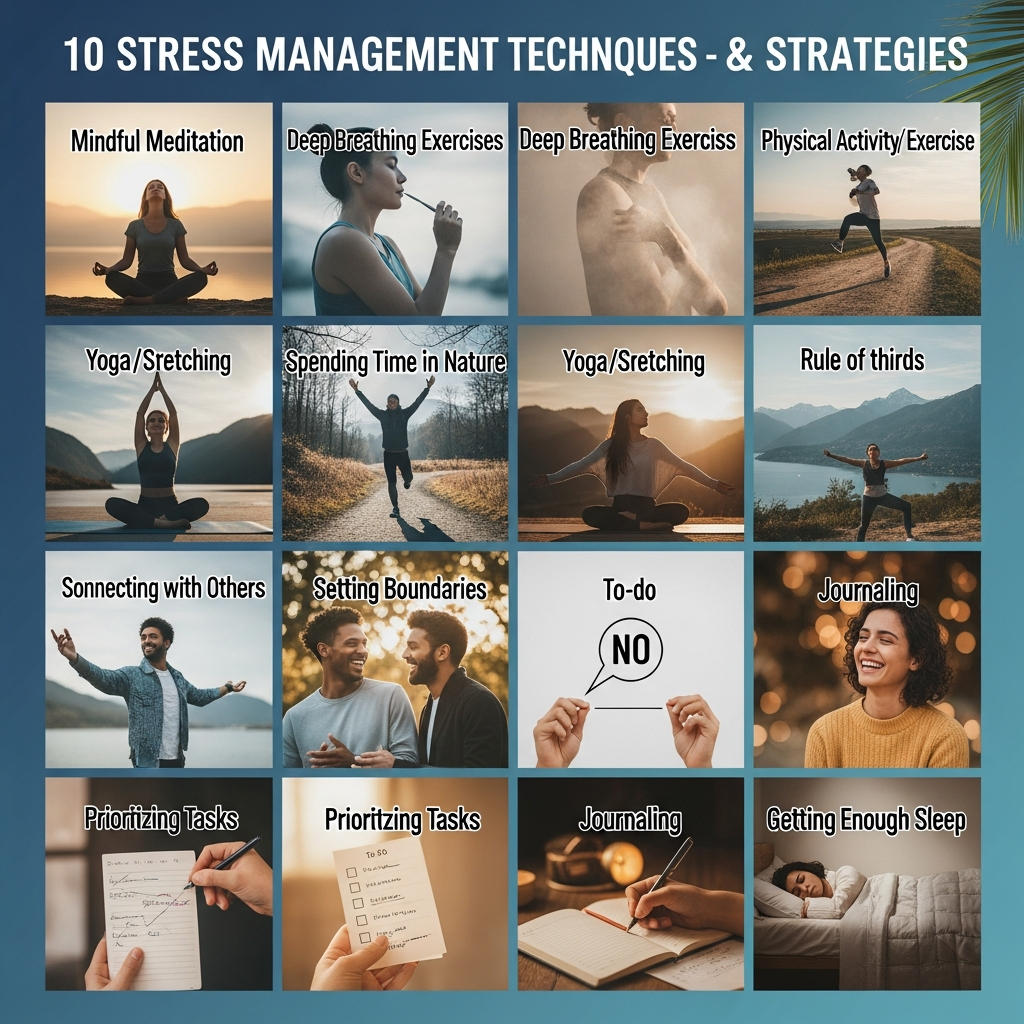
10 Stress Management Techniques That Fit Real Life
1. Practice Slow, Controlled Breathing
Breathing is one of the simplest techniques to use when you feel overwhelmed.
Stress can change breathing patterns. Some people begin breathing more quickly or shallowly without noticing it.
A controlled breathing exercise can create a short pause between the stressful situation and your response.
Try this:
- Sit comfortably.
- Relax your shoulders.
- Breathe in gently through your nose.
- Allow the abdomen to expand naturally.
- Exhale slowly without forcing the breath.
- Repeat for several cycles.
You do not need to hold your breath for a specific number of seconds unless a qualified professional has taught you a particular technique.
Research is encouraging but should not be overstated. A systematic review of breathing interventions found that several studies reported improvements in stress and anxiety, while also noting limitations in the evidence and a need for stronger randomized trials. Read the systematic review of breathing interventions.
The goal is not to “cure” stress with breathing.
The goal is to give yourself a short, accessible tool when your nervous system feels overloaded.
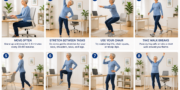
2. Walk or Move Your Body
Physical activity is one of the most practical ways to support mental well-being.
You do not necessarily need a gym membership or a complicated workout.
A walk after work, gentle cycling, stretching, or a regular exercise session can become part of your stress-management routine.
WHO recommends regular physical activity as part of maintaining mental well-being and managing stress. Read WHO’s current stress guidance.
Recent research continues to investigate the relationship between exercise and perceived stress. A 2026 systematic review and network meta-analysis of randomized trials in university students found that exercise was associated with improvements in perceived stress, although the evidence came from a specific population and should not automatically be generalized to every adult. Read the 2026 exercise and stress meta-analysis.
A practical starting point is simple:
When stress builds up, change your physical state before trying to solve everything mentally.
Walk.
Then return to the problem.
3. Try Mindfulness or Meditation
Mindfulness does not require emptying your mind.
Instead, it involves intentionally paying attention to the present moment.
You can practice for a few minutes:
- Sit quietly.
- Notice your breathing.
- Notice sounds around you.
- Notice physical sensations.
- When your mind wanders, gently return your attention.
The purpose is not to prevent thoughts.
It is to notice thoughts without automatically reacting to each one.
WHO currently includes mindfulness meditation among practical approaches that may help people manage anxiety and related symptoms. Read WHO’s current anxiety guidance.
Recent research is also examining combinations of mindfulness and physical activity, although the evidence remains heterogeneous. Read recent research on mindfulness and exercise.
4. Use Progressive Muscle Relaxation
Stress does not only affect thoughts.
It can also show up as physical tension.
You may notice tight shoulders, a clenched jaw, tense hands, or a stiff neck.
Progressive muscle relaxation involves deliberately tensing and then relaxing different muscle groups.
For example:
Hands: gently tense → release
Shoulders: gently lift → release
Jaw: notice tension → relax
Legs: gently tense → release
Do not use excessive force.
The purpose is to learn what tension feels like and practice letting it go.
WHO lists progressive muscle relaxation among relaxation techniques that may help people manage anxiety and stress. Read WHO’s relaxation guidance.
5. Protect Your Sleep Routine
Poor sleep can make stressful days harder.
At the same time, stress can make it harder to fall asleep or stay asleep.
That creates a cycle:
Stress → poor sleep → lower resilience → greater difficulty handling stress
A consistent sleep routine can help break that cycle.
Try to:
- Go to bed at a reasonably consistent time.
- Wake at a consistent time.
- Keep your bedroom comfortable and quiet.
- Reduce stimulating activities before bed.
- Avoid using the bed as a place for prolonged work.
- Address persistent sleep problems rather than simply accepting them.
NIMH recommends regular sleep as part of basic mental health self-care and notes that adults generally need around 7–9 hours of sleep. Read NIMH’s mental health self-care guidance.
6. Stay Connected With Supportive People
Stress can make people withdraw.
Unfortunately, isolation can sometimes make difficult situations feel even heavier.
You do not need a large social network.
One supportive person can be valuable.
You could:
- Call a family member.
- Talk with a trusted friend.
- Share what is actually bothering you.
- Ask for practical help when appropriate.
- Spend time with people who make you feel safe.
NIMH recommends staying connected with friends and family who can provide emotional support and practical help. Read NIMH guidance on caring for mental health
A useful distinction is this:
You do not always need someone to solve your problem. Sometimes you need someone who can listen while you work out your next step.
7. Break a Large Stressor Into One Small Action
This is one of the most practical techniques for everyday life.
When everything feels urgent, the brain may treat a long list of problems as one giant problem.
Instead, write down everything bothering you.
Then ask:
“What is one thing I can actually do today?”
For example:
Instead of:
“My finances are a disaster.”
Choose:
“I will review my last month’s expenses for 15 minutes.”
Instead of:
“My workload is impossible.”
Choose:
“I will identify the three tasks that must be completed first.”
This does not make the underlying problem disappear.
It makes the problem more actionable.
WHO’s psychological self-help approaches include practical skills for coping with difficult thoughts, emotions, and circumstances rather than simply trying to eliminate every unpleasant feeling. Read the WHO 2026 psychological self-help guidance.
8. Try Grounding During Overwhelming Moments
Grounding is especially useful when your attention feels trapped in worrying thoughts.
A simple approach is to reconnect with what is happening around you.
Try noticing:
- Five things you can see
- Four things you can physically feel
- Three things you can hear
- Two things you can smell
- One thing you can taste
This is not a cure for anxiety or a replacement for professional treatment.
It is a way to deliberately redirect attention toward the present environment.
WHO’s Doing What Matters in Times of Stress guide specifically teaches grounding and other practical psychological skills. Read the WHO stress-management guide.
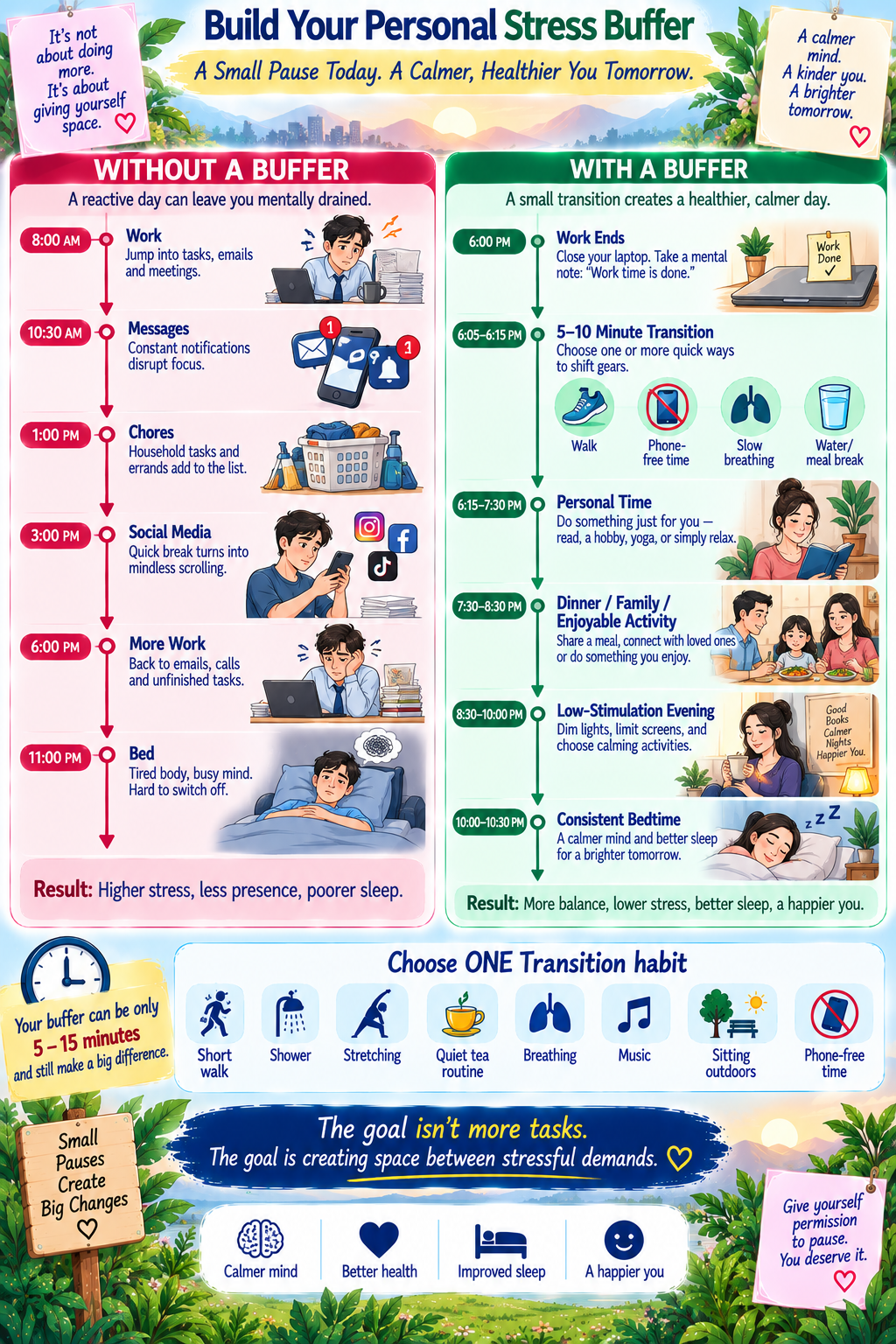
9. Create a Daily Stress Buffer
One of the most overlooked stress management techniques is preventing every minute of the day from becoming occupied.
Imagine a schedule with:
Work → phone → chores → messages → more work → sleep
There is no transition.
Instead, create a small buffer.
For example:
Work ends → 10-minute walk → dinner → family time → relaxing activity → bedtime routine
The buffer does not have to be long.
Even a few minutes can signal that one part of the day has ended before another begins.
WHO recommends maintaining a daily routine that includes time for meals, family, exercise, chores, and recreational activities. Read WHO’s stress guidance.
10. Know When Self-Help Is Not Enough
This may be the most important technique of all.
Stress-management strategies are useful for ordinary stress, but they should not become an excuse to ignore persistent mental-health symptoms.
NIMH recommends seeking professional help when severe or distressing symptoms last two weeks or more, particularly when they affect sleep, appetite, concentration, enjoyment of normal activities, or the ability to complete everyday tasks. Read NIMH’s guidance on seeking help.
Consider speaking with a healthcare professional if:
- Stress feels impossible to manage.
- You cannot perform normal daily activities.
- Sleep problems persist.
- Your appetite changes significantly.
- You experience persistent sadness or hopelessness.
- Anxiety interferes with work or relationships.
- You are increasingly avoiding normal activities.
- You are using alcohol or drugs to cope.
- Symptoms continue despite reasonable self-care.
If you are experiencing thoughts of suicide or self-harm, seek immediate emergency or crisis support rather than relying on self-help techniques.
The Stress Management Technique Most People Overlook: Ground Yourself Before Solving the Problem
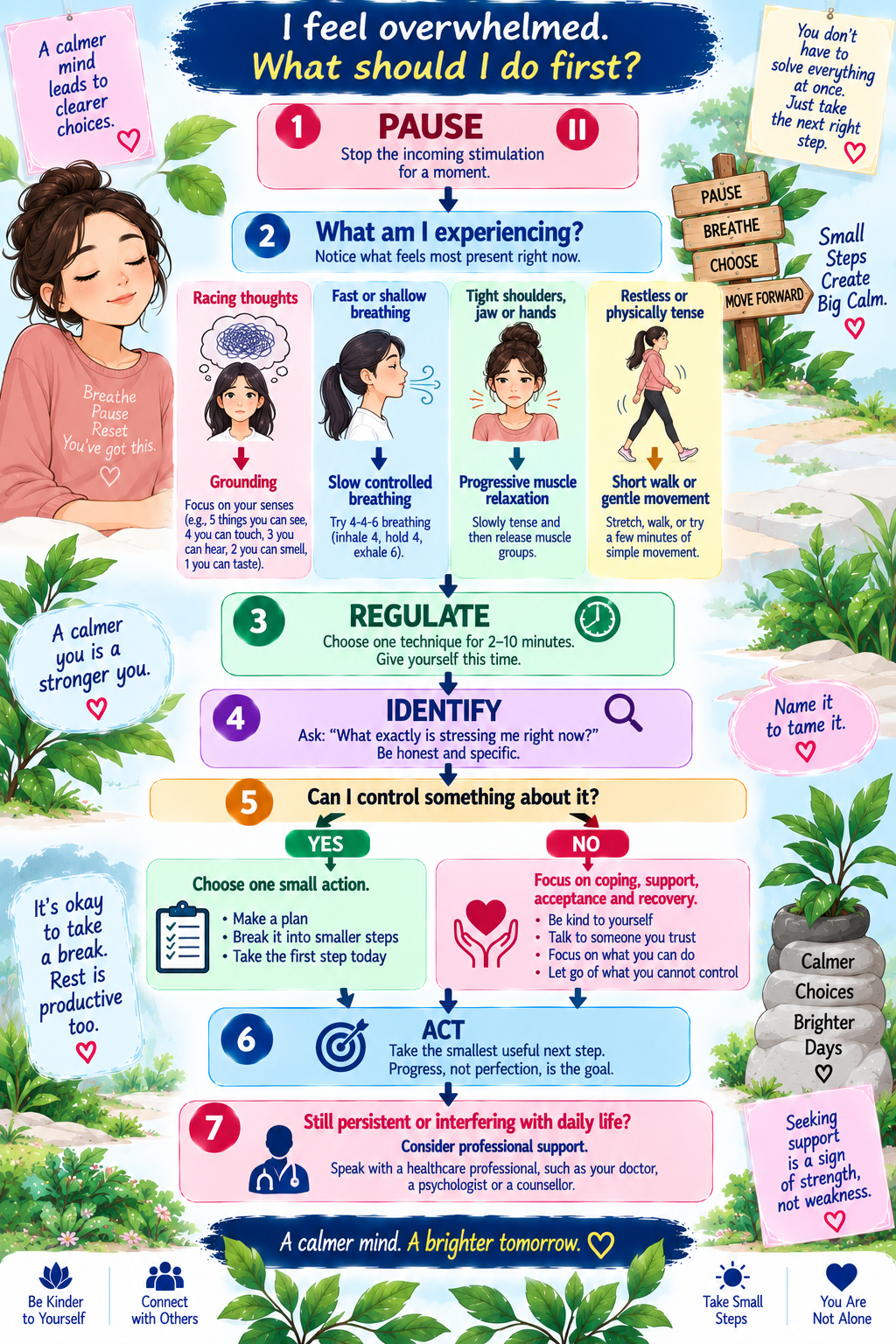
People often try to solve stressful situations while already overwhelmed.
That can make decision-making harder.
A better sequence is
Pause → regulate → identify → act
Pause
Stop what you are doing for a moment.
Regulate
Use slow breathing or another calming technique.
Identify
Ask:
“What exactly is stressing me right now?”
Act
Choose the smallest useful action.
This approach does not promise instant relief.
It simply gives your mind a clearer starting point.
A 10-Minute Stress Reset You Can Actually Do
This is a practical routine you can use when you feel mentally overloaded.
Minute 1: Stop the input.
Put your phone aside.
Stop checking messages temporarily.
Minutes 2–4: Breathe slowly.
Take comfortable breaths and lengthen the exhalation without forcing it.
Minutes 5–7: Move
Walk around the room, outside the house, or down a hallway.
Minutes 8–9: Write the stressor.
Write one sentence describing what is bothering you.
Minute 10: Choose one action.
Ask:
“What is the next useful thing I can control?”
Then do that one thing.
This routine is not a medical treatment.
It is a practical way to combine several established self-care principles into a short routine.
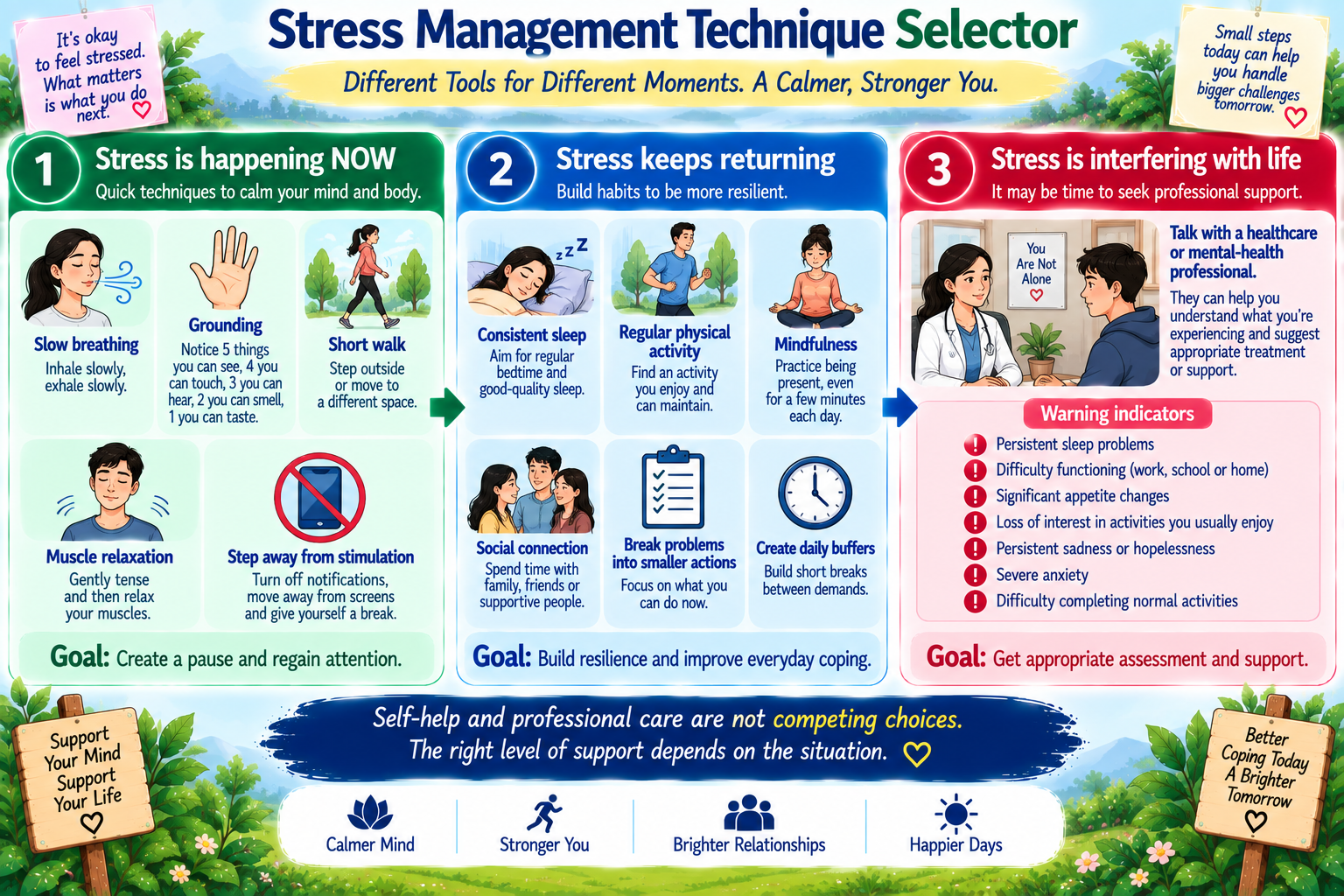
Which Stress Management Technique Should You Use?
| Situation | Technique to try | Why it may help |
|---|---|---|
| Feeling suddenly overwhelmed | Slow breathing | Creates a pause and encourages slower breathing |
| Sitting for hours | Short walk | Adds movement and changes the environment |
| Racing thoughts | Mindfulness | Redirects attention toward the present |
| Tight shoulders or jaw | Muscle relaxation | Helps identify and release physical tension |
| Poor sleep routine | Consistent bedtime routine | Supports regular sleep |
| Feeling isolated | Talk to someone. | Provides emotional or practical support |
| Too many tasks | Write one next action. | Reduces an overwhelming list into something manageable |
| Feeling mentally “stuck” | Grounding | Brings attention toward present surroundings |
| Workday feels nonstop. | Transition buffer | Creates separation between activities |
| Stress is persistent. | Professional support | Addresses problems that self-help alone may not resolve |
People-First Insight: Do Not Try Everything at Once
Many stress articles give readers 20 or 30 techniques.
That can create another problem.
The reader becomes stressed about managing stress.
Instead, start with one technique.
For example:
- Week 1: 10-minute walk each day
- Week 2: Add five minutes of mindfulness
- Week 3: Establish a consistent bedtime routine
- Week 4: Add a short breathing practice during stressful moments
The goal is not to build a perfect wellness routine.
The goal is to build a routine you can actually maintain.
What About Drinking More Water?
Hydration is important for normal health, but it should not be marketed as a primary stress treatment.
Your original article gave water a much larger role than the evidence supports.
A better message is:
Drink according to your body’s needs and your environment, but do not expect extra water to eliminate psychological stress.
Stress management should focus more heavily on evidence-supported strategies such as physical activity, sleep, relaxation, mindfulness, and social connection.
What About Herbal Tea?
A warm caffeine-free drink can become part of a relaxing evening routine.
That does not mean the beverage itself should be described as a proven treatment for chronic stress.
Chamomile, tulsi, and other herbal products have different evidence bases, and supplements or concentrated herbal products can interact with medications.
Therefore, treat herbal tea primarily as a comforting routine, not a replacement for evidence-based mental health care.
What About Screen Time?
Screens are not automatically harmful.
The issue is what you are doing on them and when.
If checking messages, social media, or work notifications keeps your mind activated late at night, a technology boundary may help.
Try a simple experiment:
30 minutes before bed → no work messages
or:
After a stressful workday → 10-minute phone-free walk
You do not need to eliminate your phone.
You need to stop allowing it to fill every quiet moment.
Stress Management and Food
Food cannot solve every source of stress.
However, regular nutritious meals can support general health.
NIMH recommends healthy eating and regular meals as part of mental health self-care. Read NIMH’s mental health self-care guidance.
A practical approach is:
- Eat regular meals.
- Include vegetables and fruits.
- Include protein-rich foods.
- Choose mostly minimally processed foods.
- Avoid using alcohol as a stress-management strategy.
- Be mindful of excessive caffeine if it makes you feel more restless.
NIMH specifically advises people who are stressed or anxious to avoid excess caffeine. Read the NIMH stress and anxiety fact sheet.
Common Mistakes When Managing Stress
Mistake 1: Trying to Eliminate All Stress
Stress is part of normal life.
The realistic goal is better coping, not creating a completely stress-free existence.
Mistake 2: Trying Every Technique at Once
More techniques do not necessarily mean better stress management.
Choose one or two.
Mistake 3: Treating Stress With Alcohol
Alcohol can temporarily change how you feel but is not a healthy long-term stress-management strategy.
Mistake 4: Ignoring Sleep
Adding meditation while sleeping four or five hours a night may miss a major contributor to your problem.
Mistake 5: Believing Every “Natural Remedy”
Natural does not automatically mean effective or safe.
This is particularly important with concentrated herbal supplements.
Mistake 6: Assuming Stress and Anxiety Are They the Same?
They overlap, but they are different.
NIMH explains that stress generally arises from an external cause, whereas anxiety can persist even when there is no current threat. Read NIMH’s stress-versus-anxiety explanation.
Mistake 7: Waiting Until You Are Completely Exhausted
Stress management works better as a regular practice than as an emergency response after months of overload.
A Simple Weekly Stress-Management Plan
| Day | Small action |
|---|---|
| Monday | 10-minute walk |
| Tuesday | 5-minute breathing practice |
| Wednesday | Talk with someone you trust. |
| Thursday | 10-minute phone-free period |
| Friday | Write down your three priorities. |
| Saturday | Longer enjoyable physical activity |
| Sunday | Review your sleep and weekly routine. |
The purpose is not to complete a perfect checklist.
The purpose is to discover which habits genuinely help you.
Latest Research: What Is Changing in Stress Management?
One of the most important recent developments is the growing focus on structured psychological self-help.
In June 2026, WHO published a new manual on psychological self-help interventions. It describes evidence-based approaches that can be delivered individually, including guided and unguided formats, and highlights Doing What Matters in Times of Stress as one of the WHO interventions supported by randomized controlled trial evidence. Read the WHO 2026 manual
WHO’s current stress-management approach is also more comprehensive than simply telling people to “relax.”
The Doing What Matters in Times of Stress guide teaches five practical skills:
- Grounding
- Unhooking from difficult thoughts
- Acting on values
- Making room for difficult emotions
- Engaging with kindness
These skills can be practiced in a few minutes each day. Read WHO’s description of these five skills
This is a useful shift for readers because stress management is not just about making unpleasant feelings disappear.
It can also involve learning how to respond differently while the difficult situation is still present.
What Recent Breathing Research Tells Us
Breathing exercises are popular because they are inexpensive and easy to perform.
But good health writing should distinguish promising evidence from proven universal effects.
A systematic review published in 2025 examined breathing interventions and found that several studies reported reductions in anxiety and stress. However, the researchers also identified methodological limitations and called for more robust randomized trials. Read the breathing-intervention systematic review
Therefore, it is reasonable to recommend controlled breathing as a low-cost technique worth trying, but not to claim that it works immediately for every person.
What Recent Exercise Research Tells Us
Physical activity is another area with growing evidence.
A 2026 systematic review and network meta-analysis examined randomized trials of exercise and perceived stress among university students. Exercise was associated with improvements in perceived stress, but differences between studies mean that the results should be interpreted in context. Read the 2026 systematic review
For a general reader, the practical message is straightforward:
Regular movement is worth including in a stress-management plan, but you do not need to turn exercise into another source of pressure.
A daily walk can be a legitimate starting point.
Personal-Experience Perspective
There is a useful lesson from everyday experience with stressful periods: complicated routines are often difficult to maintain when you are already overwhelmed.
A person who is struggling with work pressure may not need a 60-minute morning routine containing meditation, journaling, yoga, supplements, and elaborate meal preparation.
They may need something much simpler:
Take a short walk. Put the phone away. Breathe slowly. Eat a regular meal. Talk to someone. Go to bed at a reasonable time.
These habits are not guaranteed to solve the source of stress.
But they can create a more manageable foundation from which to deal with it.
Any personal experience shared in health content should remain clearly separate from clinical evidence. What helps one person may not help another.
When Should You Talk to a Doctor or Mental-Health Professional?
Consider professional help when stress becomes persistent or starts interfering with ordinary life.
Warning signs include:
- Persistent sleep problems
- Major appetite or weight changes
- Difficulty concentrating
- Loss of interest in activities
- Persistent sadness or hopelessness
- Severe irritability
- Difficulty completing everyday tasks
- Avoiding normal responsibilities
- Feeling unable to cope
- Stress or anxiety that does not improve
NIMH recommends professional help when severe or distressing symptoms last two weeks or more or interfere with normal activities. Read NIMH’s current guidance
A doctor or mental-health professional can help determine whether what you are experiencing is ordinary stress, an anxiety disorder, depression, or another condition requiring specific treatment.
Stress Is Not a Personal Failure
This is an important people-first point.
Someone can understand every stress-management technique and still experience significant stress.
Financial difficulties, caregiving responsibilities, unsafe environments, chronic illness, relationship problems, demanding work, and major life changes can create circumstances that cannot be solved simply by “thinking positively.”
WHO’s stress guidance recognizes that stress can arise from personal difficulties, work problems, and major threats in the wider environment. Read WHO’s stress-management guide
Self-care can help.
But sometimes the stressful situation itself also needs to change.
That might mean asking for help, changing a workload, setting boundaries, seeking medical care, or accessing mental health support.
The Bottom Line
The best stress management techniques are not necessarily the most complicated.
Start with the basics:
Move your body.
Sleep regularly.
Breathe slowly when overwhelmed.
Give your attention a break.
Stay connected with supportive people.
Break large problems into manageable actions.
Use grounding and mindfulness when your thoughts become overwhelming.
And most importantly, recognize when stress has moved beyond something you can reasonably manage on your own.
Current WHO guidance increasingly supports practical, structured self-help skills, while NIMH emphasizes healthy routines, social connection, exercise, sleep, and professional support when symptoms persist. Read WHO’s 2026 psychological self-help guidance. Read NIMH’s mental health guidance
You do not have to remove every stressful event from your life.
A more realistic goal is to become better equipped to pause, respond, recover, and ask for help when you need it.
Frequently Asked Questions
What are the best stress management techniques?
Useful approaches include controlled breathing, physical activity, mindfulness, progressive muscle relaxation, regular sleep, social connection, grounding, and practical problem-solving. The most useful technique can depend on the type and severity of stress.
What is the fastest way to reduce stress?
There is no single technique that works instantly for everyone. Slow breathing, stepping away from a stressful situation, taking a short walk, and grounding yourself can provide a useful immediate pause.
Can walking reduce stress?
Walking can be a practical form of physical activity and may support mood and perceived stress. It can also provide a change of environment and a break from prolonged sitting. Read current WHO stress guidance.
Does deep breathing really help stress?
Research suggests breathing interventions may improve stress and anxiety in some people, although the evidence varies and more high-quality research is needed. Read the breathing systematic review.
Can meditation reduce stress?
Mindfulness and meditation may help some people manage stress and anxiety. WHO includes mindfulness meditation among practical approaches for mental well-being. Read WHO’s guidance.
Does drinking water reduce stress?
Adequate hydration is important for health, but drinking extra water should not be considered a primary treatment for psychological stress. More established stress-management approaches include physical activity, sleep, relaxation, mindfulness, and social support.
Can herbal tea help with stress?
A caffeine-free herbal drink can become part of a relaxing routine, but evidence differs between herbs and preparations. Herbal products should not replace appropriate medical or mental health care.
How much sleep do adults need for stress management?
Most adults need around 7–9 hours of sleep per night. Consistent sleep habits can support mental and physical health. Read NIMH’s guidance.
When should I seek professional help for stress?
Seek professional help when stress becomes difficult to manage, interferes with normal activities, or occurs alongside persistent symptoms such as significant sleep problems, appetite changes, difficulty concentrating, loss of interest, or severe emotional distress. Read NIMH’s current guidance.
Author Note
Author: RVLNSV PRASAD
This article was updated in September 2026 to provide practical, evidence-based information about stress management. The article distinguishes everyday stress-management strategies from treatment for mental-health conditions and incorporates current guidance from WHO and NIMH together with recent research.
Personal-experience perspectives in this article are intended to illustrate practical habits and should not be interpreted as clinical evidence or individualized medical advice.
Medical Disclaimer
This article is provided for general educational purposes and is not a substitute for professional medical or mental health advice, diagnosis, or treatment.
Stress can sometimes be a symptom of an underlying medical or mental-health condition. If symptoms are severe, persistent, or interfering with daily activities, speak with a qualified healthcare professional.
If you are experiencing thoughts of suicide, self-harm, or immediate danger, seek emergency or crisis support immediately rather than relying on self-help techniques.
Fitness Disclaimer
Physical activity can support mental and physical health, but exercise recommendations should be adapted to your age, fitness level, injuries, and medical conditions.
If you have a significant health condition, severe symptoms, chest pain, unexplained shortness of breath, dizziness, or another concerning symptom, seek appropriate medical guidance before beginning a new exercise program.
Strong E-E-A-T Sources
World Health Organization — Stress: Questions and Answers
Current WHO guidance explaining stress, symptoms, coping strategies, routines, sleep, and physical activity.
Read the WHO stress guidance
World Health Organization — Psychological Self-Help Interventions, 2026
Recent WHO guidance on evidence-based psychological self-help, including stress-management interventions.
Read the WHO 2026 publication.
World Health Organization — Doing What Matters in Times of Stress
Practical stress-management guide covering grounding, difficult thoughts, emotions, values, and kindness.
Read the WHO stress-management guide
National Institute of Mental Health—I’m So Stressed Out!
Evidence-based explanation of stress versus anxiety and practical coping strategies.
Read the NIMH fact sheet.
National Institute of Mental Health — Caring for Your Mental Health
Guidance on exercise, sleep, social connection, healthy routines, and when to seek professional help.
Read NIMH mental health guidance
PubMed — Systematic Review of Breathing Interventions
Recent evidence examining breathing interventions for stress and anxiety.
Read the systematic review.
PubMed—2026 Exercise and Perceived Stress Meta-Analysis
Recent systematic review and network meta-analysis examining exercise interventions and perceived stress.
Read the 2026 research.
PubMed — Mindfulness and Exercise Research
Recent research examining mindfulness integrated with physical activity and emotional outcomes.
Read the research
Related Articles
- Healthy Daily Habits for Stress Reduction: A Comprehensive Guide
- 7 Natural Ways to Reduce Anxiety and Stress Daily: A Comprehensive Guide
- 22 Natural Remedies for Anxiety: What Really Works?
- 6 Mindfulness Practices for Mental Health: A Path to Inner Peace and Emotional Resilience
- 5 Meditation Techniques for Emotional Balance: A Path to Inner Peace
- Home
5 Meditation Techniques for Emotional Balance: A Path to Inner Peace
Depression and Weight Loss Treatment: Natural Remedies, Therapies, and Lifestyle Tips
7 Natural Ways to Reduce Anxiety and Stress Daily: A Comprehensive Guide






[…] 10 Stress Management Techniques and Strategies […]
[…] 10 Stress Management Techniques and Strategies […]
[…] 10 Stress Management Techniques and Strategies […]
[…] 10 Stress Management Techniques and Strategies […]